Why We Built Meridian36 in the First Place
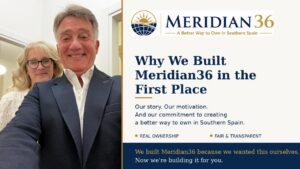
Sometimes the best businesses don’t begin with a business plan. They begin with a problem you are trying to solve for yourself.
Meridian36 began with a conversation between my wife, Kay, and me.
We love Southern Spain. The climate, the lifestyle, the food, the people, the pace of life. It is somewhere we could genuinely see ourselves spending more time.
And that naturally led to the idea of owning a home there.
But the more we thought about it, the more I kept coming back to one very simple question:
If we’re only going to use a second home for part of the year, why would we need to own 100% of it?
Buying the entire property would mean committing 100% of the capital, paying 100% of the ongoing costs, maintaining it 365 days a year and dealing with everything that comes with owning a home in another country.
All for something we might use for only a few months each year.
There had to be a better way.
We Weren’t Looking for a Timeshare
The obvious answer might seem to be timeshare.
That wasn’t what we wanted.
We wanted to own something real.
We wanted an ownership interest with proper legal documentation, clearly defined rights and responsibilities, professional management and a sensible way to eventually sell our position.
We didn’t want high-pressure sales tactics.
We didn’t want complicated points systems.
We didn’t want to wonder what we actually owned.
And we certainly didn’t want to discover years later that getting out was considerably more difficult than getting in.
So I started looking at fractional ownership and co-ownership models.
The concept made sense.
The structures often didn’t.
I Started Asking the Questions I Would Ask Before Writing the Cheque
This is where Meridian36 really began.
I stopped looking at the idea purely as a business opportunity and started looking at it as a purchaser.
What would Kay and I need to see before we were comfortable buying an ownership position ourselves?
The questions started piling up.
What exactly do we own?
How is our ownership legally protected?
How is usage allocated?
Who maintains the property?
How are monthly costs calculated?
What happens if something breaks?
Can our family use it?
What happens if another owner doesn’t pay?
What happens when we want to sell?
And perhaps one of the most important questions of all:
What happens to the owners if the company managing everything is no longer there?
Those aren’t small details.
They are the difference between an attractive idea and an ownership structure I would actually be prepared to put my own money into.
Then Meridian36 Started Taking Shape
As the idea developed, I began working with my co-founder, Katriina Raiskio-Flygare, a lawyer with extensive experience in Spain.
Together, we started working through the legal, financial and operational questions behind the concept.
Not simply:
How do we sell shared ownership?
But:
How would we want shared ownership to work if we were the purchasers?
That distinction has shaped Meridian36 from the beginning.
We wanted fair value.
We wanted clear agreements.
We wanted transparent ongoing costs.
We wanted professional management without taking control away from owners where it mattered.
We wanted a straightforward path for someone who eventually decides they want to sell.
And we wanted protections built into the structure for circumstances nobody likes talking about, including what happens if Meridian36 itself were ever unable to continue operating.
Because buying a home abroad should create freedom.
It shouldn’t create another collection of things to worry about.
Why Own More Than You Need?
That remains one of the simplest ideas behind Meridian36.
If you spend 60 or 90 days each year in Southern Spain, you don’t necessarily need 365 days of property ownership to enjoy the benefits of having a home there.
Your capital doesn’t need to sit inside an empty house for most of the year.
You shouldn’t necessarily have to manage repairs, gardens, pools, utilities, insurance and local contractors from another country.
And you shouldn’t have to choose between renting every time you visit and taking on the entire responsibility of a second home.
There is another possibility.
Own what makes sense. Use what you own. Share the costs. Have it professionally managed.
That sounds simple.
Building a structure capable of delivering it properly is considerably more complicated.
That’s what we’ve been working on.
We’re Building Something We Would Buy Ourselves
There will always be easier ways to structure a business.
But that isn’t the standard we use at Meridian36.
Whenever we face an important decision, I keep returning to the same question that started all of this:
Would I be comfortable with this if Kay and I were the ones buying?
Would I consider the price fair?
Would I understand exactly what I own?
Would I consider the agreement fair?
Would I know what I’m paying every month and why?
Would I know how to sell if our circumstances changed?
Would I feel that someone was looking after the property properly when we weren’t there?
Would I know what protections existed if something went wrong?
If I can’t answer those questions satisfactorily for myself, I don’t believe we should expect someone else to.
Meridian36 is still growing, and we will continue learning, improving and challenging our own assumptions as we build it.
But the principle behind it isn’t going to change.
We didn’t build Meridian36 by asking how little an owner needed to receive.
We built it by asking what we would expect if we were the ones buying.
And in many ways, we are.
Because this whole journey began with Kay and me imagining what it would be like to have a place of our own in Southern Spain.
We simply found ourselves asking:
Is there a better way to own it?
Meridian36 is our answer.